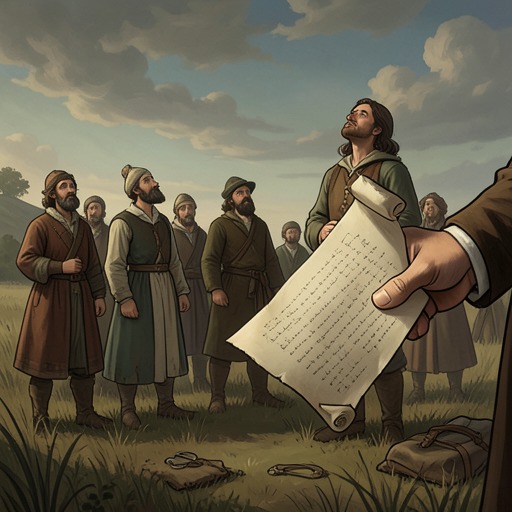
Divine Sovereignty and Human Free Agency
Book of EstherDivine Sovereignty and Human Free Agency names the central paradox the author finds in Esther: people act voluntarily and bear responsibility for their choices, while God’s providence directs even sinful actions toward purposes beyond those people’s intentions. The author treats neither side as an explanation that cancels the other. Human guilt remains real; so does divine rule. The narrative’s reversals, in this reading, make their coexistence visible without making it comprehensible.
The Governing Paradox
The author presents the distinction between divine appointment and human action as a difference of viewpoint, not a choice between competing accounts of an event. A decision may serve God’s purpose and still be freely made by the person who acts; if that decision violates God’s law, its providential usefulness does not make it innocent. Providence brings good out of evil, the author argues, without sharing in the guilt of those who do evil. This is the point the account presses through its interpretation of Esther: people pursue their own ends, yet their actions enter a larger design that they neither direct nor necessarily understand.
That claim challenges explanations that preserve one side of the paradox by discarding the other. The author objects both to treating human actions as so necessary that people cannot be blamed and to defending human freedom by denying God’s decrees. Philosophers, in this account, establish important truths about freedom and foreknowledge but cannot reconcile them into a complete explanation. The problem exceeds the reach of human understanding. The author therefore presents submission to Scripture, rather than a philosophical solution, as the appropriate response to a truth that the mind cannot fully master.
The Royal Court as a Providence in Conflict
The episodes surrounding the royal court show why the distinction matters. The author regards Ahasuerus’s order that Vashti appear before his assembled guests as an indecorous demand, contrary to Persian custom, and understands her refusal and disgrace as events that made way for Esther’s elevation. God’s purpose, in this account, is accomplished through decisions and conduct that the author does not thereby approve. Esther’s beauty and rise to royal influence likewise serve the deliverance of the Jews, but the author calls attention to the sinful human circumstances of her selection and marriage. The providential outcome does not turn those circumstances into a moral example.
The same tension attends Mordecai and Esther’s conduct. The author judges that both were guilty in their unlawful situation, and that Mordecai may have been wrong to refuse the king’s command to honor Haman. Esther, meanwhile, follows Mordecai’s counsel to conceal her Jewish descent. The author sees that concealment as one circumstance that later helped bring the Jews into danger, while Mordecai’s disclosure of his identity after others questioned his conduct exposes them to danger in another way. These choices are human actions with consequences; their place in the deliverance story does not, in the author’s judgment, excuse the violations of duty he attributes to them.
Choice, Danger, and Political Power
Haman’s rise and the command that the king’s servants honor him are also interpreted as providential. The command turned Mordecai’s refusal into a visible breach of royal authority, and the discovery that he was a Jew gave Haman grounds to direct his hostility toward the whole people. The author does not treat this chain of events as morally neutral merely because it advances the story toward its reversal. Mordecai’s conduct remains open to criticism, while Haman’s hostility and the king’s compliance remain actions for which their agents are responsible.
The king’s decision to accept Haman’s proposal places the stakes on a national scale. Haman depicts the Jews as a people whose laws differ from those of other nations and offers ten thousand talents of silver in connection with the proposed destruction. The author stresses that their religious distinctiveness is not evidence of disloyalty: they owe obedience to civil law, but are not obliged to abandon God’s commands for humanly imposed religious rites. Ahasuerus, the author observes, yields to his favorite without carefully examining the charge, although the account supplies no basis for describing him as generally cruel. The action is his; providence does not remove its injustice.
Esther’s approach to the king makes the cost of action especially clear. She faces death under the law against entering the inner court without a summons, and she has not been called to the king for thirty days. The author reads this heightened danger as part of the providential ordering of the episode, but not as proof that Esther’s risk is unreal. Her obedience requires willingness to face consequences rather than assurance that danger will be kept away. The king’s eventual acceptance of her illustrates the author’s distinction: providence may bring relief after a severe trial, but it does not make the trial imaginary or turn courage into safety guaranteed in advance.
Responsibility Without Comprehension
The account’s moral limit is consistent: a good outcome does not retroactively justify a wrongful means. The author applies this principle to Mordecai and Esther, arguing that ignorance of duty may itself be caught up in providence, yet does not cease to be ignorance or sin. A person’s beneficial role in delivering the Jews cannot establish that God approved every action by which that person came to occupy it. The author further warns that providential usefulness does not erase loss: wrongdoing may be forgiven, he says, while still carrying consequences. Obedience, even when costly, is not made a mistake by the fact that disobedience appears to produce some immediate good.
The paradox also governs the author’s reading of the imperial decree. The decree against the Jews expresses a power that appears final; the author compares its irrevocability to systems that pronounce an unchangeable judgment against those they condemn. Yet he argues that providence can make other provisions for safety and that a decree can remain in force while its power to determine the outcome is countered by other laws. In this interpretation, deliverance does not demonstrate that the threat was harmless. It demonstrates that the threat does not have the final authority.
The author extends the lesson beyond the Persian court to Christian obedience and the governance of nations. Rulers may act from purposes opposed to God, and believers may encounter hostility or loss when they refuse to surrender religious duties to human authority. The book’s events therefore console the faithful without promising an easy path: God’s rule is not defeated by hostile counsel, but that assurance does not excuse human injustice or absolve people of responsibility. The final tension remains deliberately unresolved. Human beings act and answer for what they do; God, in the author’s reading, directs history even through actions that are freely chosen and morally wrong.